

Week 4: Day 18 – Lesson
Today I want to tell you about a client I worked with many years ago. I will call him Bill.
In the mid to late 1990s I was working in Manchester as the Orchestral Coordinator for the BBC Philharmonic. My job was to book extra players, find last‑minute replacements and keep the orchestra at full strength for whatever repertoire was on the schedule. Over those five years I got to know many freelance musicians and became friends with some of them.
During my Alexander training in Kendal, I picked up weekend and holiday work backstage at the Royal Northern College of Music concert hall. I loved the variety of it. Some days were lively and full of activity, problem solving and being with creative people at the height of their musical and emotional expressions. Others were long stretches of staring at a lime green wall with no windows, waiting to be needed.
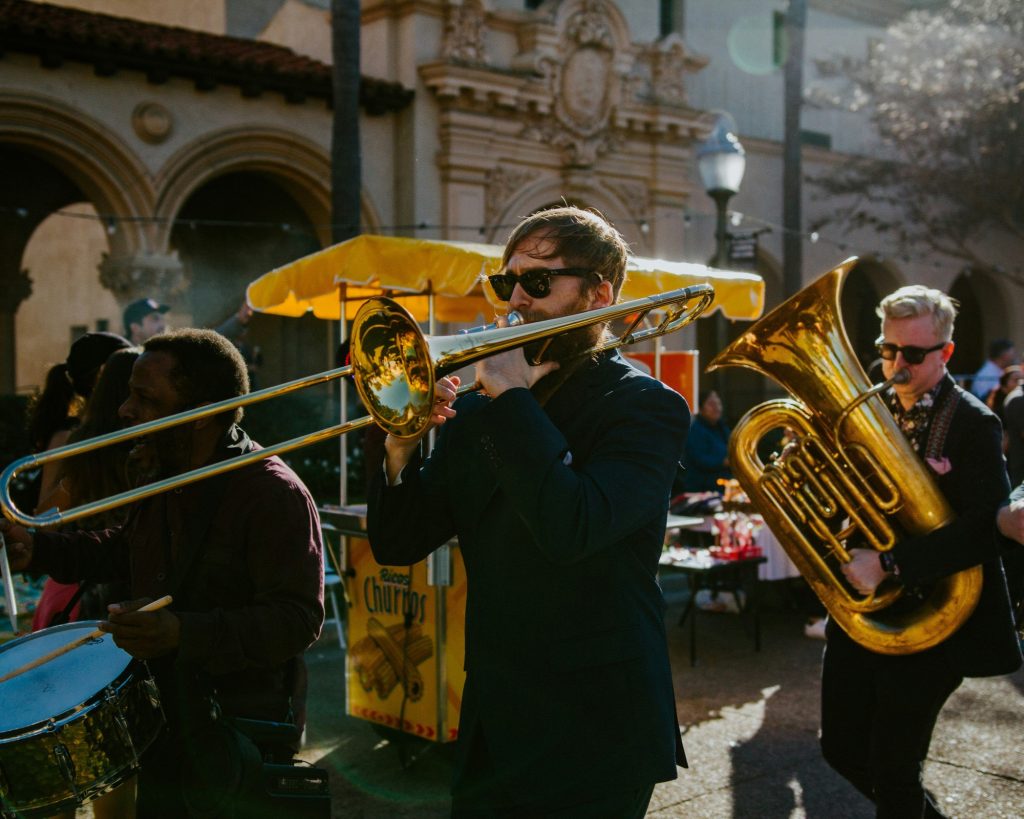
During one of those quiet spells I got talking to a brass player. A big man with a big instrument. We knew each other from my BBC days. He told me he was having trouble breathing and that it was threatening his career. He could not get enough air for the loud passages he needed to play. I offered to see what I could do with my fledgling Alexander skills, and he agreed.
I was daunted. He was barrel‑chested and powerful, and even at 5′ 10″ I felt very small next to him. But I stuck to principles. We got to know each other and through the work he began to get to know himself in new and subtle ways. I was not sure anything was happening at first, but I kept going, like a gardener tending a patch of ground. Small interventions. Careful observation. Patience.
I watched him breathe. I placed my hands around his ribs and felt where they moved – where they did not. One day I realised something important. He could draw in a lot of air, but he was not letting go enough. His problem was not inhaling. It was exhaling. His ribs were not softening or gathering much. His chest was not condensing enough for his lungs to release the old air.
We talked about the fact that chest’s are not fixed, like barrels, he learned how ribs are designed to move and flex. I put my hands on and pushed so he could feel the direction where his ribs could go. When he finally started to release his chest, he released something else too. Old emotions. Old holding. Old stories.
Our culture teaches boys early to stop crying, to be a big boy, to wipe their tears, to be a man. The bigger the man, the louder that message seems to be. Do not show emotion. Do not feel too much. Do not let anything leak out. That emotions are a sign of weakness, of being unmanly!
But the body keeps the score in its own way. Whether that is in the lungs, the fascia or the nervous system, something in us holds on, gets frozen, fixed, when expression is shut down. When one part of us stops flowing, the rest of us feels it indirectly.
“My moving you around is not going to help you when you leave this room. The manner in which you take the responsibility will. My hands are a guide. It allows you to gain a great deal of confidence in your own thinking.” Marjorie Barstow
As his chest began to move more freely, his breath changed. His body softened. His range increased. He could breathe out more fully, and therefore more space for breath to come in more fully. And yes, sometimes tears came. Our work became a safe place for him to be embodied without demands or expectations. A place where he could be sensitive, sensory and smaller than he was used to being.
Over time his breathing became fuller and more elastic. His playing improved. His career has continued for another two decades and counting.
He arrived with a passion and a question that stretched me far beyond my comfort zone. I could not match his musical expertise, and this is important, I was not there as a musician. But I could meet his curiosity. I could meet his willingness. I could meet his courage. And I helped retrain his thinking, so that when he left my teaching room, he had some new information, new ways of thinking, and ultimately new solutions for a very important problem.
He taught me that the limits of the work are not where I think they are. The possibilities are far wider. When someone brings their whole self to the process, the work meets them there. The warm touch, the curiosity, the accompaniment, the relational safety all contribute to unlearning cultural norms which shape and limit us in hidden ways.